

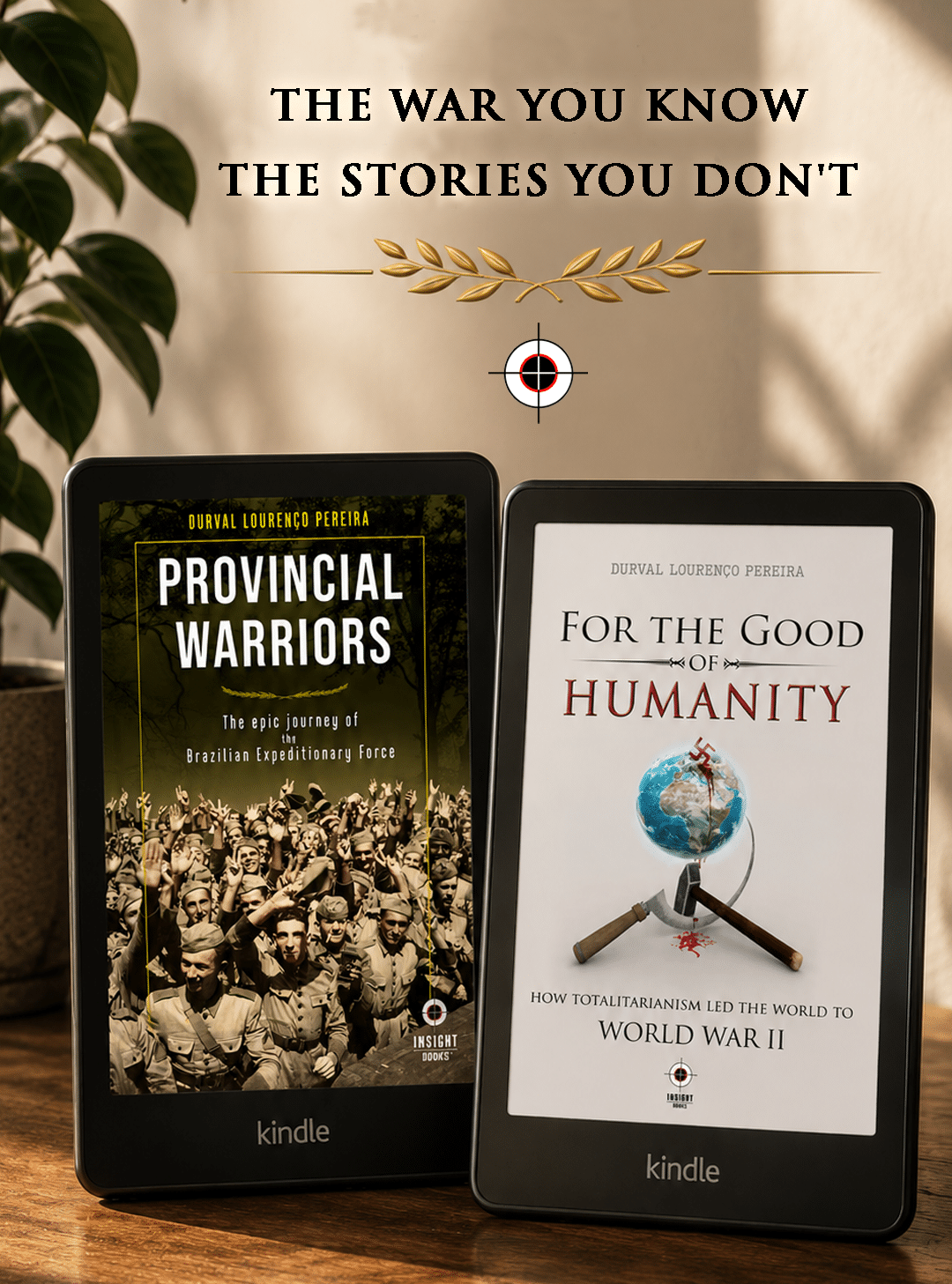
Provincial Warriors: The Untold Story of Brazil’s Citizen-Soldiers in World War II
For decades, the history of the Brazilian Expeditionary Force (FEB) in World War II has been told through official reports, military memoirs, and broad accounts of the Italian Campaign. Yet behind every battle, every victory, and every sacrifice stood thousands of ordinary men whose personal stories have remained largely unknown.
Provincial Warriors, by historian Durval Lourenço Pereira, seeks to restore those voices to history.

Drawing upon years of meticulous archival research, military records, official correspondence, personal documents, and contemporary newspapers, the book offers a compelling portrait of the Brazilian soldiers who left their hometowns to fight alongside the Allied armies in Italy during the Second World War.
More than a military history, Provincial Warriors is a story about courage, duty, sacrifice, and the enduring human experience of war.
The Men Behind the Uniform
History often celebrates armies, divisions, and commanding generals. This book focuses instead on the individuals who made those institutions meaningful.
The soldiers of the Brazilian Expeditionary Force came from every corner of Brazil. Many had never traveled far from their hometowns before being called to serve overseas. Farmers, laborers, students, clerks, craftsmen, and professionals suddenly found themselves crossing the Atlantic to fight in one of history’s most devastating conflicts.
Their backgrounds differed, but they shared a common commitment: serving their country in the struggle against tyranny.
Through carefully documented biographies and historical narratives, Provincial Warriors introduces readers to these remarkable individuals—not merely as soldiers, but as sons, fathers, husbands, friends, and citizens whose lives were forever transformed by war.
A Documentary Approach to Military History
One of the defining strengths of Provincial Warriors is its extensive use of primary sources.
The research draws upon official military archives, personnel files, operational reports, period newspapers, private collections, and numerous historical documents preserved in Brazil and abroad. These sources allow the author to reconstruct individual experiences with a level of detail rarely found in traditional military histories.
Rather than relying solely on established narratives, the book encourages readers to revisit familiar events through newly examined documentary evidence, offering fresh insights into Brazil’s wartime experience.
Preserving the Legacy of the Brazilian Expeditionary Force
Nearly eighty years after the end of World War II, the generation that fought in Italy has almost entirely passed into history.
As eyewitnesses disappear, the responsibility for preserving their legacy increasingly falls upon historians, researchers, museums, educational institutions, and future generations.
Provincial Warriors is part of that effort.
By documenting the lives of Brazilian combat veterans with historical accuracy and respect, the book contributes to preserving an important chapter of Brazil’s national memory while making that history accessible to readers beyond the country’s borders.
A Brazilian Story with Universal Significance
Although centered on the experience of Brazilian soldiers, Provincial Warriors speaks to a universal audience.
Every nation that participated in World War II was represented by ordinary citizens who answered extraordinary calls to service. Their stories transcend nationality, reminding us that the cost of freedom has always been measured in individual lives, personal sacrifices, and acts of courage.
The experiences of the Brazilian Expeditionary Force form an integral part of that global history.
By bringing these stories to English-speaking readers, the book broadens international understanding of Brazil’s contribution to the Allied victory and highlights a chapter of World War II that deserves far greater recognition.
Bringing Brazilian Military History to the World
The English-language edition of Provincial Warriors reflects Memorial da FEB’s ongoing commitment to promoting Brazilian military history on the international stage.
For many readers outside Brazil, the existence of the Brazilian Expeditionary Force remains one of the least-known aspects of the Second World War. Yet more than 25,000 Brazilian soldiers served in Italy between 1944 and 1945, participating in key operations alongside American and other Allied forces.
Their achievements, sacrifices, and legacy deserve to be studied as part of the broader history of the Allied victory.
Provincial Warriors seeks to help fill that gap by presenting carefully researched scholarship in an accessible and engaging narrative for historians, military professionals, students, and general readers alike.
You can find the book at Amazon Kindle Store.
For the Good of Humanity: A Brazilian Perspective on How Totalitarianism Led the World into World War II
After years of research conducted in Brazilian, American, and European archives, historian Durval Lourenço Pereira is preparing the English-language edition of his latest work, For the Good of Humanity: How Totalitarianism Led the World into World War II.
More than a translation of the original Portuguese edition, this publication is an effort to introduce international readers to a broader interpretation of the political, ideological, and historical forces that ultimately plunged humanity into the deadliest conflict in modern history.

Rather than focusing solely on the military campaigns or diplomatic crises that immediately preceded the outbreak of war in 1939, the book argues that World War II was the culmination of a much longer process. It examines how the gradual erosion of democratic institutions, the expansion of authoritarian governments, and the rise of competing totalitarian ideologies transformed international politics and made global conflict increasingly inevitable.
Looking Beyond a Single Regime
The history of World War II is often presented through the lens of Nazi Germany alone. While National Socialism undeniably played a central role in the conflict, this book encourages readers to consider a much wider historical landscape.
During the interwar years, several totalitarian movements emerged across Europe and beyond. Although they differed in ideology, they shared fundamental characteristics: the concentration of political power, suppression of dissent, state control over information, extensive propaganda, and the subordination of individual rights to the interests of the State or the ruling party.
These regimes did not merely reshape their own societies—they profoundly altered the international balance of power. Their ambitions, rivalries, and ideological conflicts created an environment in which war became increasingly likely.
Understanding this broader context is essential to understanding why the Second World War became possible.
History Built on Documentary Evidence
One of the defining characteristics of Durval Lourenço Pereira’s work is its reliance on primary sources.
Throughout his research, the author examined thousands of pages of official documents, military records, diplomatic correspondence, intelligence reports, and archival material preserved in institutions across Brazil, the United States, and Europe.
Readers of Memorial da FEB are already familiar with this research methodology. Previous studies have brought to light little-known documents concerning Brazil’s participation in World War II, the operations of the Brazilian Expeditionary Force (FEB), and numerous historical episodes that continue to generate debate among scholars.
The English edition seeks to extend this work beyond Portuguese-speaking audiences, making its research accessible to historians, students, military professionals, and readers around the world.
The Enduring Lessons of Totalitarianism
Although the events examined in this book occurred more than eighty years ago, their historical significance remains remarkably relevant.
Totalitarianism rarely arrives announcing itself openly. More often, it advances gradually, presenting itself as a necessary solution to social instability, economic crisis, national security, or even the collective good. Throughout history, authoritarian governments have frequently justified the concentration of power by claiming to act “for the good of humanity.”
That paradox lies at the heart of this book.
The twentieth century witnessed millions of people deprived of liberty—and, in many cases, of life itself—in the name of political projects that promised a better future for society. Regardless of ideological orientation, whenever governments place unlimited power above individual freedom, history demonstrates the risks that inevitably follow.
For the Good of Humanity invites readers to examine those historical patterns carefully, recognizing that understanding the past remains one of the strongest safeguards against repeating it.
Bringing Brazilian Scholarship to an International Audience
The publication of this English edition also represents an opportunity to introduce Brazilian historical research to a wider global audience.
Despite Brazil’s strategic importance during World War II—and the distinguished service of the Brazilian Expeditionary Force in the Italian Campaign—Brazilian scholarship has often remained underrepresented in international historiography.
By publishing this work in English, Insigth Books hopes to contribute a Brazilian perspective to the broader academic discussion surrounding the origins of World War II, encouraging dialogue based on documentary evidence, critical analysis, and historical inquiry.
You can find the book at Amazon Kindle Store.



Deixe um comentário